1. Intro to Animation-System
Before diving deeper into Animation-Systems, let's take a step back and try to understand what is animation.
Earlier I mentioned that "Animation means to move things" which is kinda a crude definition. Putting it more formally, Animation is an illusion of motion created by displaying still-images in a rapid succession. In games and movies mostly two types of animations are created,
1. figure animations(like robots, humans, animals and much more) (Fig-1.0) and
2. an animation for some natural-phenomenon(like wind, fire, plants and much more) (Fig-1.1)
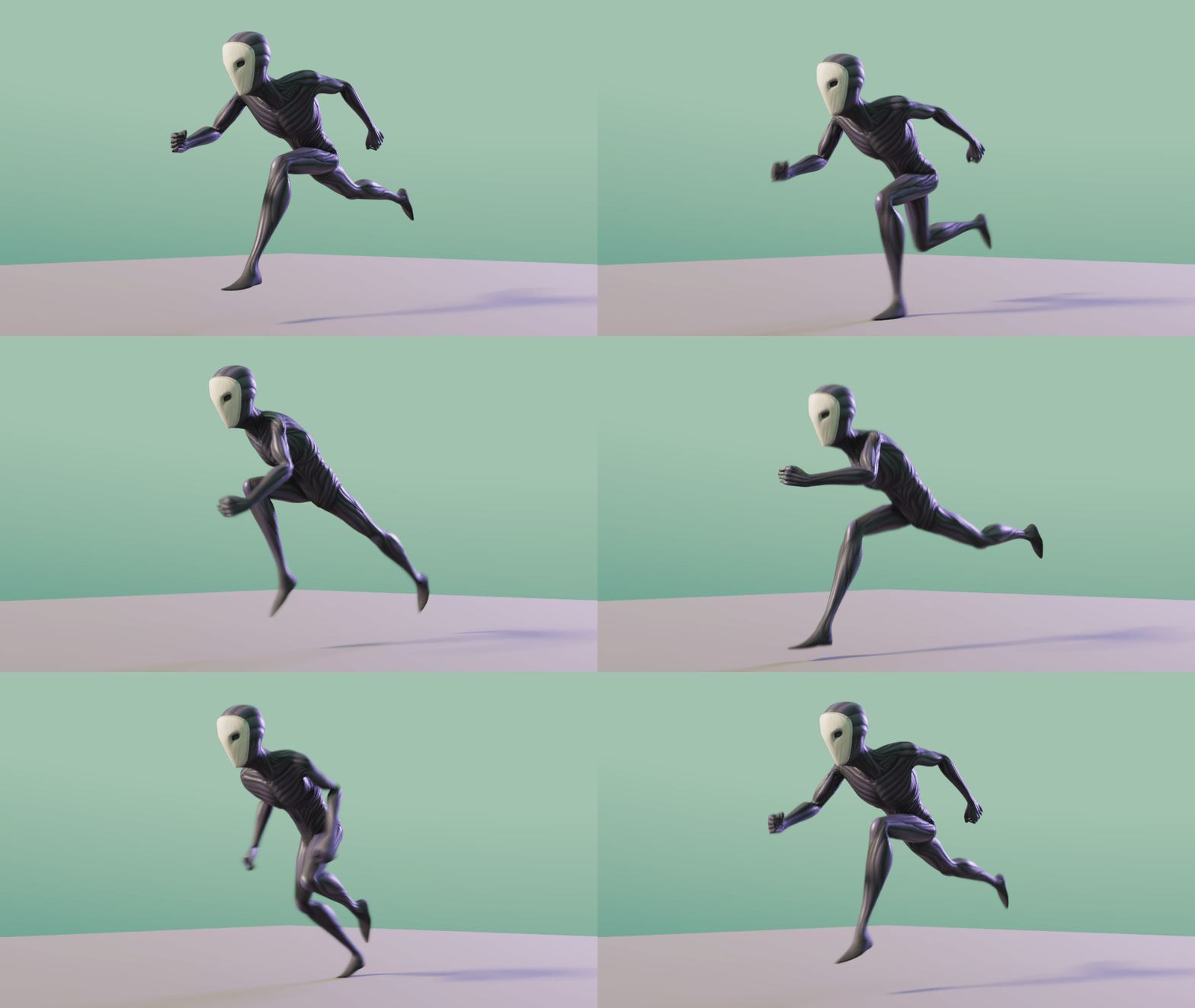
Fig-1.0 (Animation by Austin Calhoun)

Fig-1.1 (Animation by Ian Genskowsky Chang)
Apart from the types of animations we discussed above, there are two methods for creating computer-based animations.
1. Computer-Assisted Animations (Fig-2.0) and
2. Computer-Generated Animations (Fig-2.1)
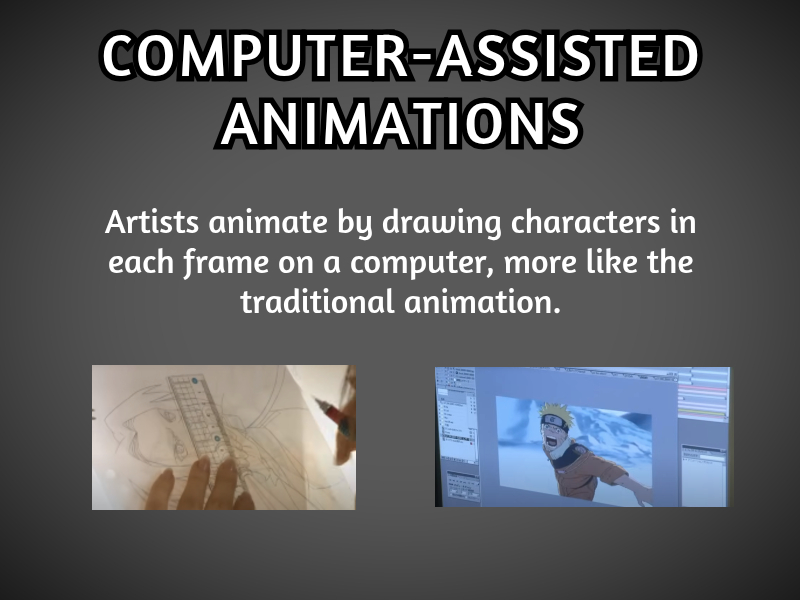
Fig-2.0 Computer-Assisted Animations
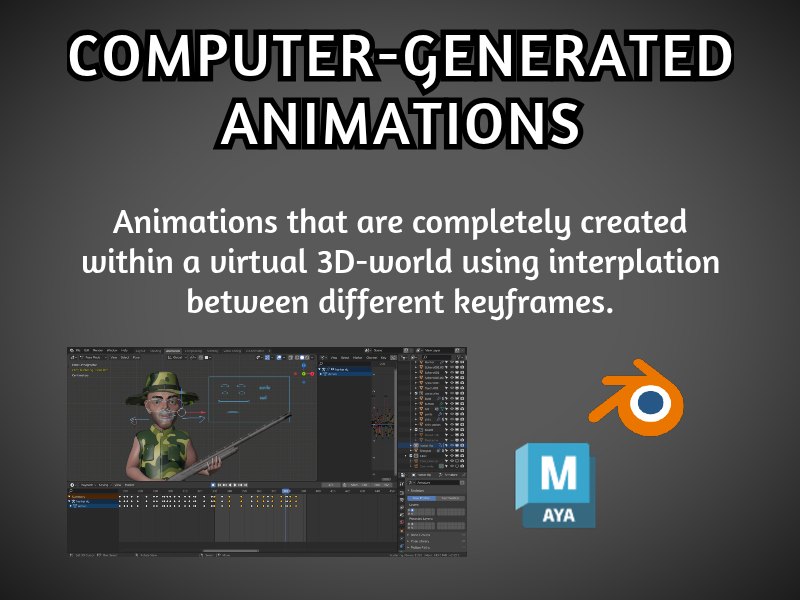
Fig-2.1 Computer-Generated Animations
In this series we'll be focusing on the Computer-Generated Animations part and try to create two levels of abstraction so that any artist who uses our tool gets tools as per his/her needs. We'll work on making keyframe-level tools which will give the artist precise, low-level control of the animation and a higher-level of abstraction, which won't give much finer control but will make artist's life easier.
Any value in the engine/program which can be changed can be animated. Be it, Position, Orientation, Shape-Of-Object, Shading-Parameters, Texture-Coordinates(Used for 2D-sprite-sheet based animations), Light-Source Parameters and Camera Parameters, just to name a few.
Why Do We See Animations?
Images can quickly convey a large amount of information, it's because the human-visual-system is a sophisticated info-processor. Moving-images(Animation) have even more potential to convey information. Animation is created by displaying still-images in a quick-succession, which is then converted into a single moving-object by our eye-brain complex. Let's understand the fundamental concept that makes all this possible.
Persistence Of Vision
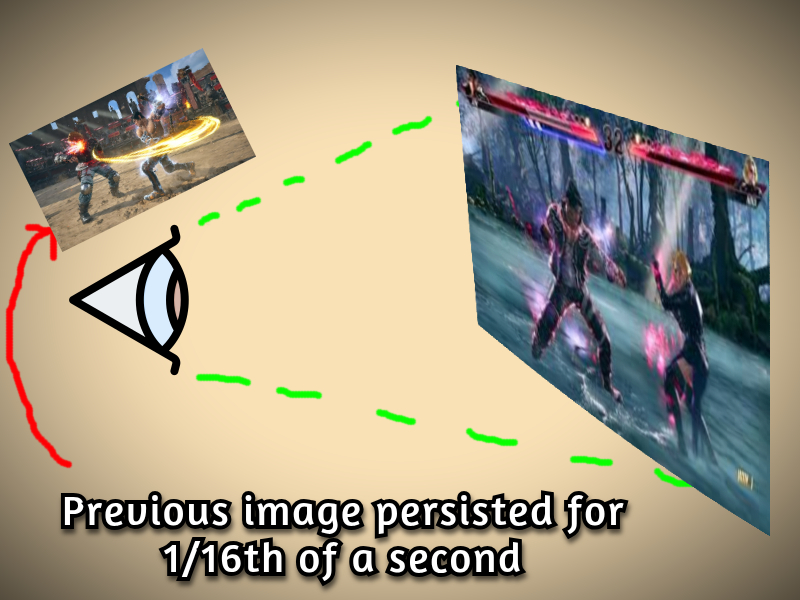
Fig-3.0 Persistence Of Vision
The single image presented to the viewer for a short time will leave a short imprint of itself (The positive afterimage) in the visual-system for 1/16th of a second. Then our brain uses this image for filling the gap till we see another image (kinda like interpolating between frames). If we didn't have this ability then any animations or even real-life moving objects would appear like a fast-scrolling slide show (The perception of continuous imagery fails to be created), and the image is said to flicker.
Depending on the lighting conditions and viewing distance and other parameters, the rate at which still-images must be played-back changes in order to maintain the perception of motion (as the persistence of vision varies). The rate at which the still-images are played-back is known as the flicker-rate. Note that, you must not mistake persistence of vision with perception of motion, they are both completely different phenomenona. Let's understand it with help of an example.
Imagine rotating a light-bulb tied with a string in a circular-fashion. You'll not see the light-bulb at discrete locations but you'll see a ring formed, tracing the path of the light-bulb. This is because the persistence of vision, the after image of the bulb at angle 0 still remains while the bulb sweeps the whole circle, which effectively creates a static Super-Imposition of all points on the circle (See Fig-3.1). Leaving you with a ring like light. Take a look at Fig-3.2, it's from a fireshow but conveys the same idea.
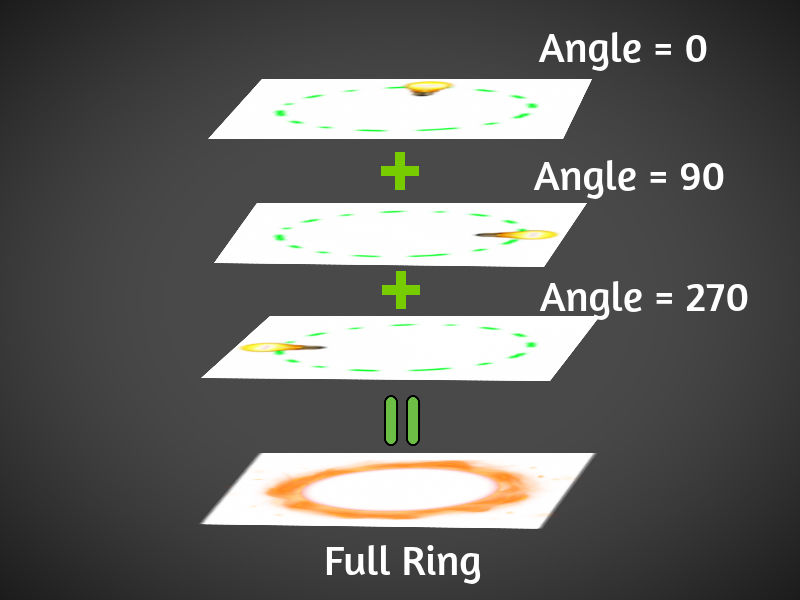
Fig-3.1 Super-Imposition Of Bulb At All Angles

Fig-3.2 Fireshow Trick Demonstrating Persistence Of Vision
This happens due to something known as the Phi-Phenomenon. It doesn't only Super-Impose still-images but combine them all by interpolating into a single moving image. Now, for the perception of motion. Imagine multiple different light-bulbs arranged in a circle, each bulb is lit sequentially giving a perception of motion, but here the persistence of vision is not involved. This makes it clear that for perception of motion we require slightly different still-images and that perception of motion is higher-level phenomenon than persistence of vision. Take a look at Fig-3.3.

Fig-3.3 Figure Demonstrating Perception Of Motion
There is also a limit to what our eyes can perceive(Unless we have a sharingan). This is due to limitations of the receptors in our eyes and this leads to something known as a motion blur. I'll leave this one out for my next blog.
NEXT-BLOG: 2. Animation Systems - Getting Technical